東京 [Tokyo], アソカ 書房 , [1954]. Edited by Suyama Keiichi (須山計一).
8vo. 196, [1] pp., ill.
Japan’s war and occupation as the world’s cartoonists drew it.
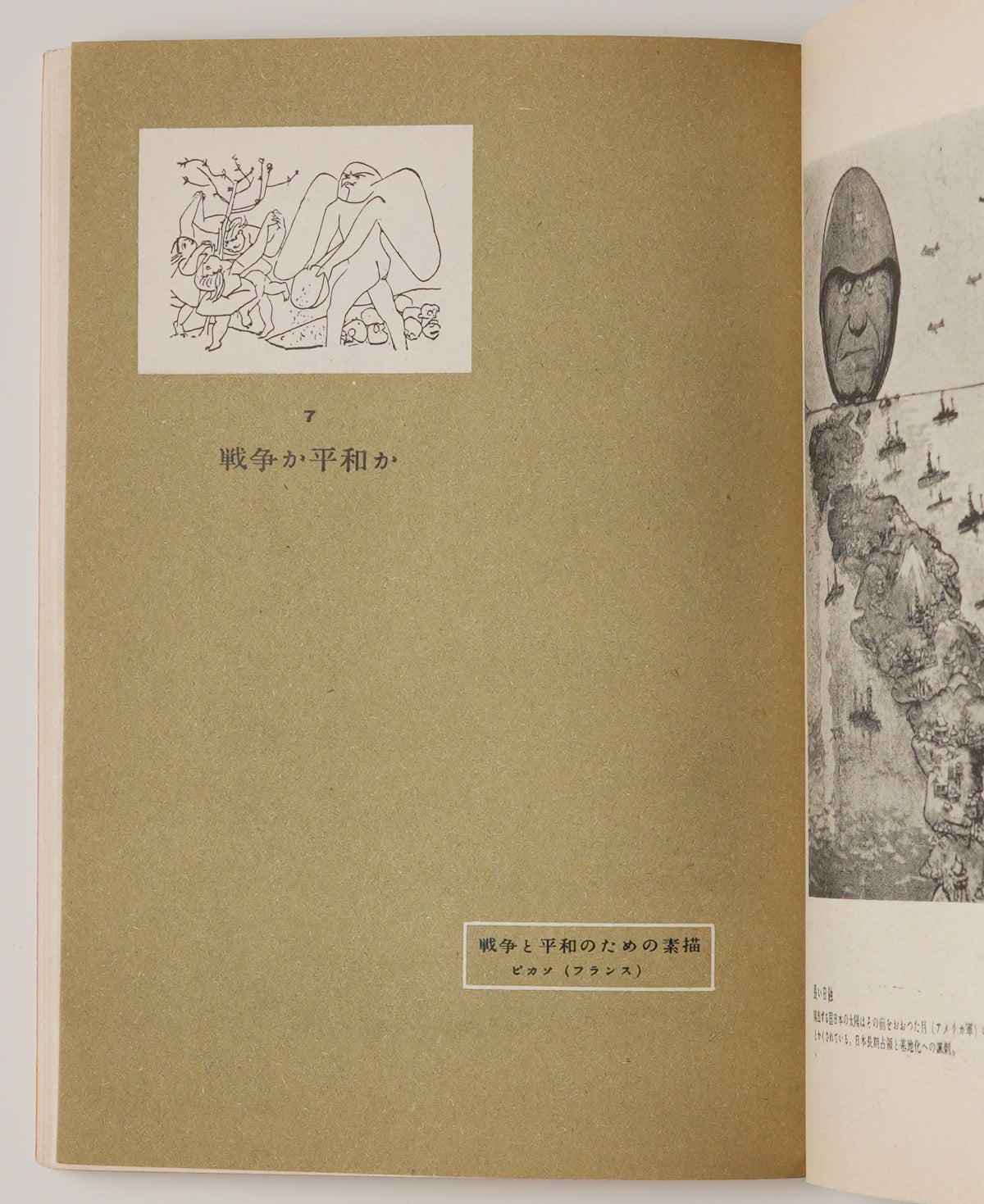
Published in Tokyo in 1954, two years after the Allied occupation ended, this anthology gathers editorial cartoons, posters and comic strips from the international press, tracing Japan's passage from its wartime identity through defeat, occupation and reconstruction, from the 1930s to the early 1950s. The wrappers reproduce Boris Yefimov's "American Freedom" — a Soviet propaganda image on the cover of a Japanese book, and the first indication of the company kept inside.
The images were created by artists from various countries, including Sir David Low (UK), Rollin Kirby, Fred Ellis, Ed Doughty (USA), Picasso, Jean Effel (France), George Grosz (Germany), Kukryniksy, Boris Yefimov, Yuliy Ganf (USSR), Mi Gu/米谷, Li Binghong/黎冰鸿, Hua Junwu/華君武 (China), Sugiura Yukio/杉浦幸雄, Kitaoka Fumio/北岡文雄, Yokoyama Taizō/横山泰三, Ogiwara Kenji/荻原賢次 (Japan), among others.
These works depict prominent figures of the era, such as Winston Churchill, Chiang Kai-shek, Franklin Roosevelt, Yasuji Okamura, Benito Mussolini, Joseph Stalin, Harry S. Truman, Matthew Ridgway, and Douglas MacArthur. Significant events covered include Japan's invasion of mainland Asia, World War II, the American occupation, the Korean War, the Treaty of Peace with Japan (Treaty of San Francisco), and the Mutual Security Agreement (MSA), among others.
The book concludes with an afterword by its compiler, Suyama Keiichi (須山計一; 1905–1975) — in his lifetime the leading authority on manga criticism in Japan, a Western-style painter and cartoonist, and, in 1931, secretary-general of the Japan Proletarian Artists Alliance, an affiliation that explains much about the selection. In this afterword, Suyama reflects on his wartime and postwar experiences, providing fascinating insights into various Japanese artists he was close to (including the death of Yanase Masamu [柳瀬正夢]), the lives of foreigners who remained in Japan during the war, the public's evolving attitude toward the emperor, postwar prostitution in Japan, the impact of thermonuclear weapons testing, and more. He concludes the afterword by detailing the specific magazines and newspapers from which he sourced the images used to compile the book.
Binding & condition
Original pictorial wrappers with the cover after Boris Efimov’s "American Freedom", in the printed slipcase. Good: light wear to the wrappers, small tears to the spine, small losses to the slipcase edges, bookseller’s ticket to the slipcase verso.
Rarity
OCLC locates four copies outside Japan.