Lewis, Sinclair
Main Street: A novel. ルイス・シンクレーア 「本町通り」メーン・ストリート: 長篇小說
Main Street: A novel. ルイス・シンクレーア 「本町通り」メーン・ストリート: 長篇小說
Couldn't load pickup availability
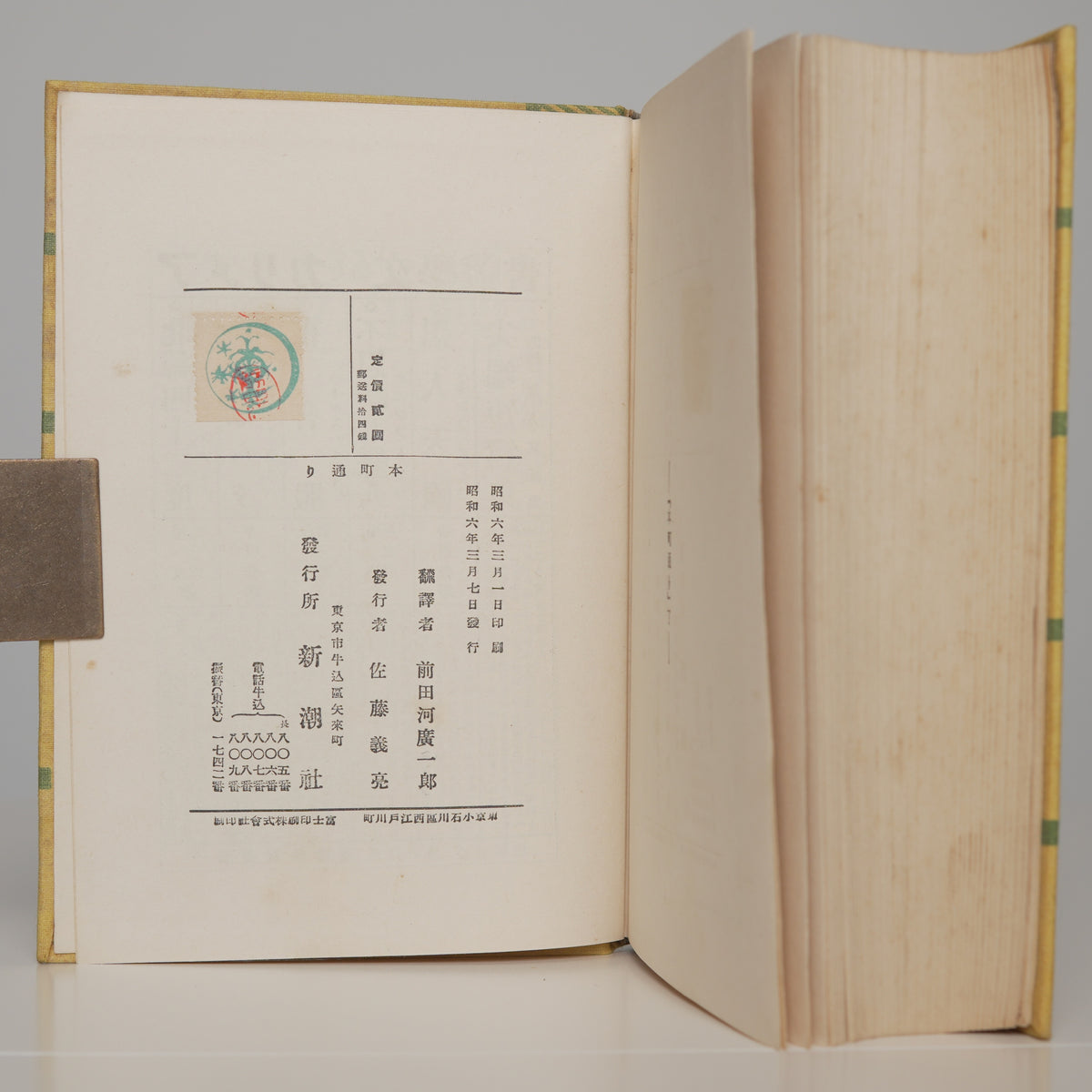
東京 [Tokyo], 新潮社, 昭和6 [1931].
Translated from the English by Maedakō Hiroichirō, with his preface (前田河広一郎).
8vo. [3], 1-16, 691, [5] pp.
Lewis's first book to appear in Japan, and the only edition of this translation. Designed by an unrecorded artist — a notable instance of deluxe publishing at the height of Japan's early-1930s economic crisis.
Main Street (1920), an American classic by Sinclair Lewis (1885–1951), became the author's first book to appear in Japanese — published the year after Lewis was awarded the Nobel Prize in Literature, the first American writer to receive that honor. Until then Lewis had remained little known among Japanese readers, even though a 1923 silent film adaptation of Main Street had been screened in Japan; it was the Nobel award that prompted this first Japanese translation.
That is why Maedakō Hiroichirō (前田河広一郎; 1888–1957) — a well-known Japanese novelist and this book's translator — felt obliged to introduce the writer to his compatriots: his preface sets out Lewis's biography and career and offers a critique of his work (Main Street and Elmer Gantry). As one of the leading figures of the Japanese proletarian-literature movement, however, Maedakō criticizes Lewis sharply. He faults him for being a sharp, honest observer of American bourgeois life who never crosses into genuine class struggle: his satire exposes hypocrisy and provincialism, but stops at reformist, petty-bourgeois critique rather than confronting the roots of capitalism. In short, Maedakō judges him a gifted realist, but politically no more than a social-democratic "fellow traveler," not a proletarian writer.
It is also worth noting the translator's own story. Maedakō studied under Tokutomi Roka, a well-known Japanese writer and philosopher, and in 1907, with Roka's support, went to the United States. Over the following thirteen years there he drifted through a series of jobs — dishwasher, door-to-door salesman, gardener, reporter for a Japanese-language newspaper, among others — and during this period published short stories in English. He returned to Japan in 1920 and became a well-known proletarian writer. However, as the crackdown on the left intensified from the late 1920s onward — culminating, most notoriously, in the 1933 arrest and beating to death of Kobayashi Takiji by the special political police — Maedakō, too, effectively disappeared from the literary scene. This book can thus be counted among the last imprints of Japan's proletarian-literature movement before the country's politics turned decisively militarist.
Binding & condition
Original yellow cloth, stamped in colors, with pictorial slipcase featuring a portrait of Sinclair Lewis. Without dust jacket, as issued. Good: slipcase rubbed, with small losses and tears, owner’s mark in red pencil to top, minor soiling to cloth.
Share