Maruki Iri & Maruki Toshi
Hiroshima. Хиросима
Hiroshima. Хиросима
Couldn't load pickup availability
Moskva, Sovetskii khudozhnik, 1959. Preface by Mikhail Kotov.
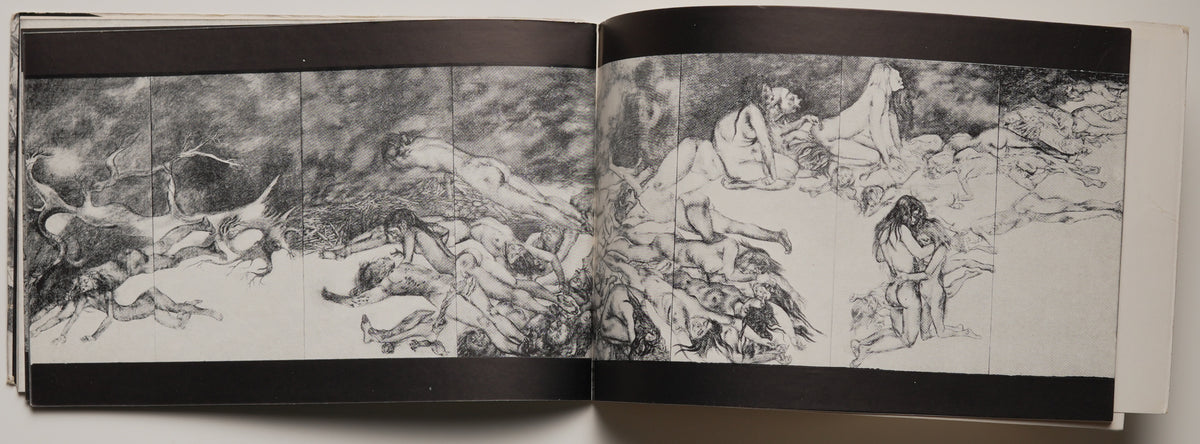
Oblong 8vo. 16, [27] pp., ill.
Catalogue of the Marukis' Moscow exhibition of 1959 — the first solo exhibition held in the USSR by any contemporary Japanese artist.
Maruki Toshi (丸木俊; 1912–2000) and her husband Maruki Iri (丸木位里; 1901–1995) are best known for The Hiroshima Panels (原爆の図), a series of painted folding screens on the aftermath of the atomic bombings. In 1945, days after the bombing, the two travelled to Hiroshima to help surviving members of Iri's family and became first-hand witnesses to what had happened there. They began work on the panels two years later. American censorship during the occupation made the work difficult to exhibit; even so, the panels did much to make visible a destruction that was barely being reported. In January 1953 the World Peace Council awarded the Marukis its International Peace Prize, and by the late 1950s the panels were touring internationally.
Contemporary Japanese art, meanwhile, was almost unknown in the USSR. A few showings of Japanese children's art and cinema in the late 1920s were followed by a long freeze: relations soured by 1930, many Japanologists were repressed during the Great Purge, and wartime exchange stopped altogether. Japanese contemporary art returned only in 1956, shown to a selected audience drawn largely from the art world, and in 1957 more widely, as part of the International Exhibition at the 6th World Festival of Youth and Students. Two years later the Hiroshima Panels were installed in one of the pavilions of Gorky Park in Moscow, and the exhibition afterwards toured several Soviet cities. The Marukis' pacifism suited Soviet policy, which is much of why the exhibition happened at all.
The Marukis went on to become the principal channel between the two art worlds. With no formal cultural agreement in place, they used personal connections to bring young Japanese artists to the USSR, to organise group exhibitions and to enrich Soviet museum holdings; in the 1960s the Union of Artists and the Soviet Peace Committee went so far as to allocate funds towards a peace museum in Japan. After the Marukis left the Japanese Communist Party and visited the United States in 1970, their names fell under an unofficial ban, surfacing thereafter only in connection with the Hiroshima Panels. They nonetheless remained, to the end of the Soviet period, the emblem of contemporary Japanese art.
In 1995 the Marukis were nominated for the Nobel Peace Prize. In 2024 the prize was awarded to Nihon Hidankyo, the confederation of atomic-bomb survivors' organisations founded in 1956, "for demonstrating through witness testimony that nuclear weapons must never be used again" — the same work of witness the Marukis had done in paint.
Binding & condition
Original wrappers and pictorial dust jacket. Good: light wear and minor losses to the jacket spine. An additional staple was inserted in error during binding.
Rarity
OCLC locates a single copy — Amherst College Library.
Share