Orwell, George
Nineteen Eighty-Four (1984). ジョージ・オーウェル 一九八四年
Nineteen Eighty-Four (1984). ジョージ・オーウェル 一九八四年
Couldn't load pickup availability
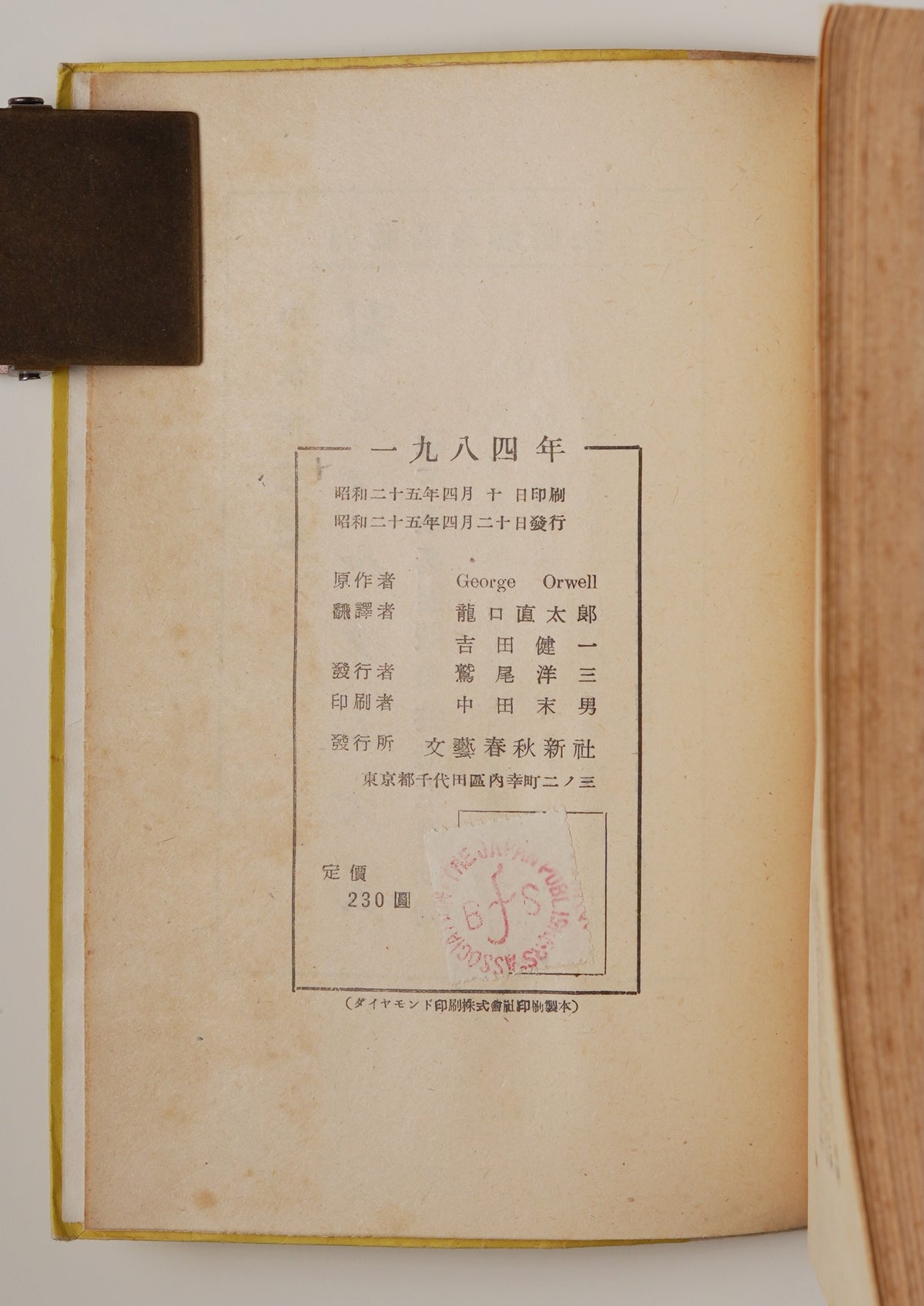
東京 [Tokyo],文藝春秋新社, 昭和25年 [1950]. Translated from the English by Yoshida Ken'ichi (吉田健一) and Tatsunokuchi Naotarō (龍口直太郎), with the translators' introduction, including the appendix, "The Principles of Newspeak".
12mo, [2], 386, [2] pp.
First complete Japanese translation (first edition, first printing). First complete translation into an East Asian language, and one of the earliest translations of the novel into any language.
Nineteen Eighty-Four first appeared in Japanese in November 1949, in abridged form, in the Japanese edition of Reader's Digest (リーダーズダイジェスト), in its regular section 新刊書の要約("Condensations of New Books"). The American magazine had been published in Japanese since June 1946, during the Allied occupation. Five months later, on 20 April 1950, 文藝春秋新社 (Bungei Shunju Shinsha) published the first complete Japanese translation, by Yoshida Ken'ichi and Tatsunokuchi Naotaro. The translation was reissued only once, in 1958.
The book opens with the translators' introduction, in which Orwell and the novel are presented to a Japanese readership. The translators dwell on totalitarian political control — with no reference, of course, to Japan's own recent militarism — and close on individual freedom, asking whether the Japanese fail to feel the question acutely because they do not yet know the value of freedom of thought and feeling. The choice of Orwell was in a sense reciprocal: during the war, working for the BBC's Eastern Service, he had written a great deal about Japan and occupied China, and dated the beginning of the Second World War not to 1939 but to the Japanese invasion of Manchuria in 1931.
Especially interesting is the figure of Yoshida Ken'ichi (1912–1977), writer and literary critic, and the eldest son of Yoshida Shigeru, who was Japan's prime minister when this translation appeared. As a diplomat's son he spent much of his childhood in France, Britain and China, and studied English literature at King's College, Cambridge, under Goldsworthy Lowes Dickinson. Known as an eccentric, he was often at odds with his father: according to a well-known anecdote, after one quarrel cut off his allowance, he sat outside the International Press Club in Tokyo with an upturned hat and a sign reading "Prime Minister's son — penniless", counting on his father's embarrassment to restore it. Orwell stayed with him: in 1966 he published a translation of Animal Farm. Here he translated Part Three, while Parts One and Two and the Newspeak appendix were done by Tatsunokuchi Naotaro (1903–1979).
The book also carries the translation-rights licence of the occupation authorities (GHQ/SCAP, Civil Information and Education Section), which auctioned translation rights to foreign titles: exclusive rights were granted to the publisher from 17 December 1949, a month before Orwell's death. The English title is printed with a misprint, "Ninteen Eighty-Four".
Binding & condition
Original wrappers and pictorial dust jacket. Good: light wear and minor losses to the jacket spine foxing to the verso of the jacket, wrappers, and edges, toning to the first and last two leaves from contact with the jacket flaps, small ownership stamp to rear free endpaper.
Rarity
OCLC records only two holdings outside Japan, at UCL and the British Library.
Share