Pusenkoff, George
Mona Lisa Goes Russia
Mona Lisa Goes Russia
Couldn't load pickup availability
Heidelberg, Kehrer Verlag, [2002]. In German and English.
Oblong 4to. 87, [1] pp., ill.
The first catalogue devoted to this conceptual-photographic project.
In 1974, Leonardo da Vinci’s Mona Lisa was exhibited in Moscow for 45 days, in what became one of the most remarkable cultural events of the Soviet era. The painting had travelled to Moscow after its exhibition in Japan, and its appearance in the Soviet Union was made possible through a remarkable diplomatic arrangement. The exhibition attracted enormous public attention: visitors reportedly waited in line for 7–10 hours to enter the Pushkin Museum, while attendance figures range from more than 310,000 to as many as 1.5 million visitors, depending on the source. It was the last time the Mona Lisa left the Louvre for a public exhibition.
George Pusenkoff (b. 1953) emerged from the milieu of Moscow's nonconformist art scene of the 1970s and 1980s, receiving important impulses from the avant-garde surrounding Ilya Kabakov and Erik Bulatov. In 1990, on the invitation of gallerist Hans Mayer, he relocated to Cologne, where he has lived and worked ever since, developing a signature idiom that merges digital image-making with icons of art history.
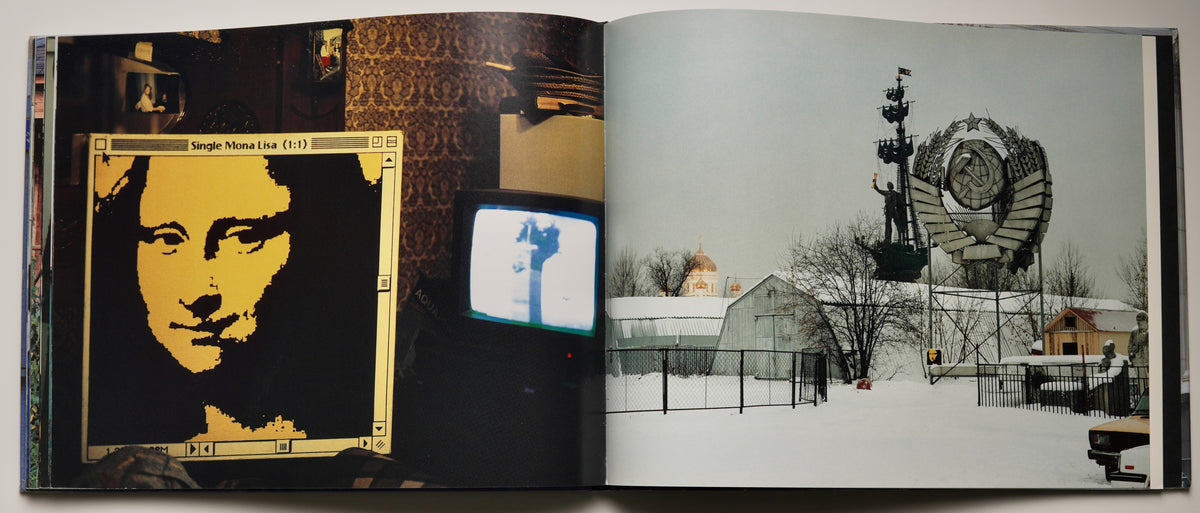
George Pusenkoff’s Mona Lisa Goes Russia is deeply connected to the memory of that extraordinary exhibition. Beginning in 1997–98, the Russian-German artist travelled across Russia with his own painted version of the Mona Lisa, created in the tradition of Pop Art, particularly that of Andy Warhol. The artist photographed it in a wide variety of urban and rural settings — from Red Square and museums to provincial villages, private interiors and everyday scenes.
As Hans Gercke writes in this 2002 exhibition catalogue accompanying the project, “it is not the art believers who make pilgrimages to the Mona Lisa, but rather she herself makes her own missionary pilgrimage across the country.” Pusenkoff’s Mona Lisa was deliberately created through digital manipulation: the artist based the image on a reproduction found on the Internet, transforming the canonical masterpiece into a black-and-yellow, computer-age icon.
The resulting photographs explore not only the creation, reproduction and perception of images, but also questions of intercultural communication and the dialogue between old and new, East and West, the Russian icon and the Western “icon”, the digital and the real. By placing Leonardo’s most famous image against the rapidly changing landscape of post-Soviet Russia, Pusenkoff creates a surreal and often ironic portrait of a country caught between the remnants of the Soviet past and the uncertain possibilities of a new era. The Mona Lisa becomes both an outsider and a witness, carrying the cultural weight of European art into unfamiliar surroundings while absorbing new meanings from the places she encounters.
The project had a sequel: on April 15, 2005 (Leonardo’s birthday), the painting was delivered to the International Space Station by Italian astronaut Roberto Vittori and returned to Earth on April 24, 2005. The project was subsequently presented as part of the 51st Venice Biennale under the title Mona Lisa Goes Space.
Binding & condition
Original pictorial boards. Good: light rubbing to corners and spine edges; bookseller’s label to rear board.
Share