[Exhibition catalogue]
Under the Twinkling Great Bear: Drawings of Internment in Siberia. きらめく北斗星の下に: シベリア抑留画集
Under the Twinkling Great Bear: Drawings of Internment in Siberia. きらめく北斗星の下に: シベリア抑留画集
Couldn't load pickup availability
[Tokyo], シベリア 抑留画集出版委員会 , 1989. In Japanese, with a short foreword in English.[Slipcase illustrated with artwork by Yasuo Kazuki].
4to. 229, [3] pp., ill. Errata sheet inserted.
The Gulag drawn from the inside — by the Japanese who were held in it.
In September 1945, in defiance of the Potsdam Declaration, some 575,000 disarmed Japanese soldiers taken in Manchuria, northern Korea, Sakhalin and the Kuriles were sent not home but to labour camps across Siberia. Around 55,000 died there. The last of them did not reach Japan until eleven years later, to little official acknowledgement; the subject only entered wider Japanese public memory in the 1980s.
Among the internees were a considerable number of artists, professional and amateur alike. They were, unexpectedly, allowed to draw — and were at times commissioned by camp administrations for propaganda work. What survives is a body of images of Soviet camp life made by the prisoners themselves, and it has almost no counterpart anywhere. The nearest comparison is Danzig Baldaev, whose Gulag drawings reached Western readers through FUEL's "Drawings from the Gulag" — but Baldaev drew as a guard. These men drew as inmates.
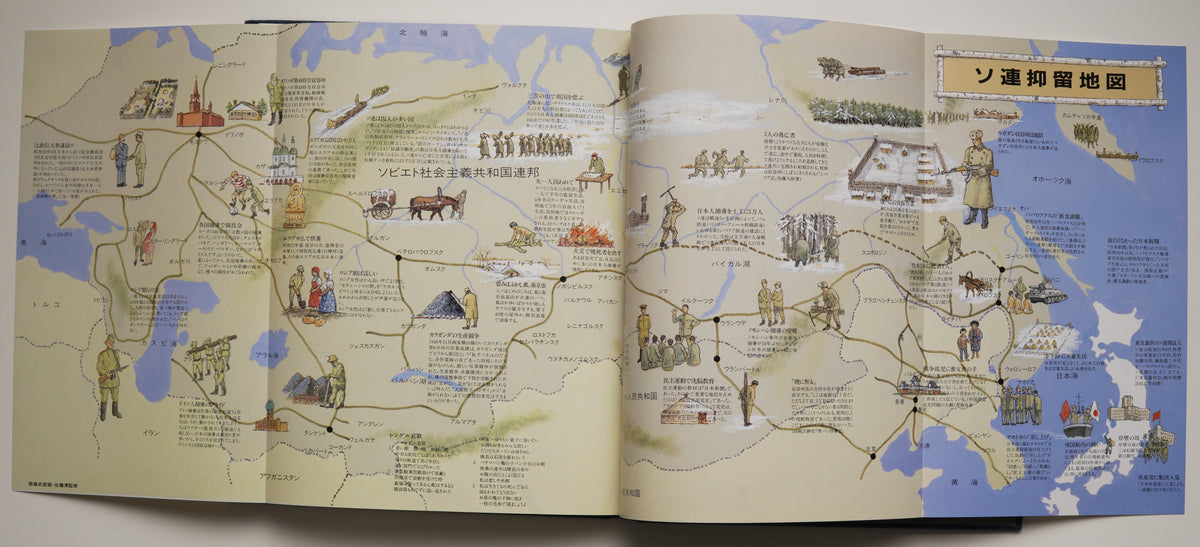
Published to accompany a ten-day exhibition in Shinjuku, Tokyo, in 1988 — the first of its kind — the album gathers work by forty-six artists, from the canonical to the entirely obscure: Kazuki Yasuo (香月泰男, 1911–1974), whose Siberia series is the best-known Japanese artistic response to the camps; Satō Chūryō (佐藤忠良, 1912–2011); Yokoyama Misao (横山操, 1920–1973); Onosato Toshinobu (オノサト・トシノブ, 1912–1986); Kiuchi Nobuo (木内信夫, 1923–2021). Each is given a biography, an exhibition history and, most valuably, his own recollections of internment. Maps of the camp network are included.
Internees were generally not permitted to carry their work home, which makes three inclusions exceptional: watercolours executed during captivity by Murata Seizō (村田精三), Furuta Takuzō (古田卓造) and Satō Takeo (佐藤健雄). The volume also reproduces photographs of a wooden Buddha carved at Yelabuga camp in 1947 and of a violin built by a prisoner in 1946.
Binding & condition
Original dark blue cloth with silver staples to the front board, in the original pictorial slipcase illustrated with artwork by Kazuki Yasuo. Good: slipcase spine lightly bumped, light curling to the upper corner of the first leaves.
Rarity
OCLC locates five copies outside Japan.
Share